

How AI Search Is Reshaping the Modern Buyer Journey | Part 1
Two-Part Series: AI & the Modern Buyer Journey | You are reading Part 1 of 2
Is Your Brand Even in the Room? New consumer research confirms what we have been watching in our clients' data for over a year. Here is what the numbers actually mean for your business.

After more than two decades advising businesses on digital marketing strategy, I have watched a handful of genuine inflection points: the launch of Google AdWords, the rise of social media advertising, and mobile-first indexing. What is happening right now with AI-assisted search belongs in that same category. The question is no longer whether AI is changing how customers find you. A major new study settles that. The question is whether your brand is positioned to benefit.
In late 2025, Semrush surveyed more than 1,000 U.S. consumers who had experience using AI tools, mapping exactly how those tools fit into real purchase decisions.1 The findings align closely with what we have been observing across our clients’ traffic and conversion data over the past eighteen months. In this first installment, I want to focus on the behavioral data of what consumers are actually doing and why the implications run deeper than most marketing teams have yet to account for. Next week in Part 2, we will get practical: a framework for what your business should do about it.
The Usage Numbers Are No Longer Fringe
The first thing that should catch a marketer’s attention is the sheer frequency of AI tool usage among the surveyed population. This was not a group of tech enthusiasts it spanned all income brackets and age groups, with roughly equal representation from consumers aged 18–34, 35–54, and 55 and older.1 Among those with AI experience, 85 percent are engaging with these tools at least once a week, and nearly half use them every single day.
Equally telling is platform concentration. ChatGPT commands the largest monthly active share at 64 percent, followed by Google’s Gemini at 49 percent. Meta AI reaches 39 percent of respondents through its embedded placement across Facebook, Instagram, and WhatsApp.1 For most businesses, the relevant playing field is relatively compact. You do not need to optimize for a dozen platforms. But you do need to show up meaningfully in the ones that matter, and right now, most brands have no idea whether they do.
AI Has Not Replaced Search It Has Made the Journey More Complex
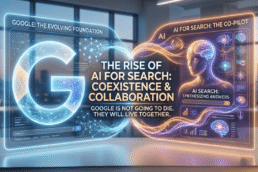
One of the more nuanced findings in the data is that AI and traditional search are not competing with each other in the minds of most consumers. Seventy-seven percent of respondents use both together within the same purchase journey.1 Search engines remain the more common entry point at 33 percent of research sessions versus 26 percent for AI, but a meaningful 18 percent alternate fluidly between the two throughout a single decision process.
This is not the “Google is dead” narrative that has circulated in some corners of the industry. It is something more complicated, and in some ways more demanding for marketers: you now need to earn visibility in two distinct ecosystems that operate on different logic, reward different signals, and present information in entirely different formats.
Ranking well on Google is no longer sufficient on its own. Your brand needs a presence in the answers that AI tools are constructing—because that is where the shortlist is being built.
Triangle Direct Media
What the data also shows is that AI summaries compress the early phase of research rather than replace what comes after. Eighty-seven percent of respondents say AI helps them understand brands faster, and 68 percent visit brand websites just as often or more than before their AI usage increased.1 And critically, 94 percent of users click links in AI responses at least sometimes.1 A citation in an AI answer is not a dead end; it is a high-intent referral. Most brands are leaving that pipeline completely untouched.
AI Operates Across the Full Purchase Funnel, Not Just the Top
Perhaps the finding most relevant to businesses running multi-channel campaigns is how evenly AI usage is distributed across purchase stages. This is not a top-of-funnel awareness tool that fades out when the decision gets serious. Among the surveyed consumers:
- 51% use AI during early discovery and category exploration
- 57% use it to narrow down a consideration set they have already begun to form
- 53% use it to compare specific products they are actively evaluating
- 50% use it to reach a final purchase decision and 25% do this daily1
The implication is significant. A brand that appears in AI responses for awareness-stage queries but drops out in comparison and decision queries is losing customers mid-funnel at the precise moment they are most ready to act. Visibility in AI responses needs to be consistent across the full journey, not front-loaded.
Experts Advice
In our experience at Triangle Direct Media, brands that have invested in structured, detailed content—the kind that directly answers specific comparison questions tend to surface more consistently in AI-generated responses. The survey data confirms the logic: 52% of consumers specify constraints like budget, required features, or use case upfront when querying AI.1 If your content does not address those specifics, it is unlikely to appear in the answer.
This is not the “Google is dead” narrative that has circulated in some corners of the industry. It is something more complicated and, in some ways, more demanding for marketers: you now need to earn visibility in two distinct ecosystems that operate on different logic, reward different signals, and present information in entirely different formats.
Discovery Is Real But Position in the Response Is Not What Drives Attention
Forty-three percent of respondents report discovering a brand they did not previously know through an AI tool.1 For businesses still treating AI visibility as a secondary concern, that figure deserves some attention. It represents a meaningful share of new customer acquisition happening through a channel most brands are not actively managing.
Here is where the data gets particularly instructive: being mentioned first in an AI response confers surprisingly little advantage. Only 20 percent of respondents say a brand stands out because it appears earlier in the answer.1 What actually earns attention is the quality and specificity of the description. Forty-three percent say a clearer, more detailed explanation makes a brand stand out. Thirty-nine percent are influenced by price or value context. Thirty-seven percent respond to descriptions that speak directly to their specific situation.1
This is a fundamentally different dynamic than traditional search, where position one commands a disproportionate share of clicks regardless of snippet quality. In AI responses, the brand described most precisely and relevantly wins regardless of where it falls in the answer. The mandate for content strategy shifts accordingly: the goal is not to game position. It is to ensure the description of your brand in AI outputs is accurate, specific, and tailored to the questions your customers are actually asking.
Trust Is Conditional and Verification Is the Norm
Seventy-five percent of respondents rate their trust in AI recommendations at three or four out of five confident enough to begin a purchase journey on the basis of an AI response, not confident enough to skip verification before committing.1 Eighty-six percent say they verify AI brand recommendations at least sometimes, with 20 percent doing so every single time.1
Google is the primary validation channel at 68 percent, followed by brand websites at 48 percent, review platforms and YouTube both at 35 percent, and friends or family at 33 percent.1 This verification behavior carries a direct implication: a mention in an AI response sends consumers straight into your organic search footprint and your review ecosystem. If either is weak, thin, or contradicts the picture the AI painted, you are not just missing a conversion you are actively generating awareness for a competitor who shows up more convincingly at the validation stage.
What This Means For Your Business
Our SEO and content strategy services focus on exactly this kind of holistic visibility—ensuring your brand holds up not just at the discovery stage, but at every verification touchpoint a prospective customer is likely to hit afterward. That means well-structured website content, an actively managed review presence, and the kind of authoritative third-party coverage that AI systems draw from when constructing their responses.
Sources & References
- Loktionova, M. & Skopec, C. (2026, March 5). How AI Tools Influence the Modern Buyer Journey: A Survey of 1,000+ US Consumers. Semrush Blog. https://www.semrush.com/blog/ai-tools-the-modern-buyer-journey-study/ All consumer survey statistics cited in this article are drawn from the Semrush study referenced above, conducted in December 2025 among 1,030 U.S. consumers with prior AI tool experience.
Not Sure How Your Brand Shows Up in AI Search?
Triangle Direct Media has helped businesses build measurable digital presence for over 20 years. Let us take a look and show you exactly where you stand.
Triangle Direct Media has been serving businesses across the Triangle and the USA for over 20 years.