

Creating content for your website is easy. Creating content that works together to support your SEO strategy, answer customer questions, and contribute to business growth takes considerably more planning. That’s where pillar and subtopic content come in.
Instead of treating every blog post as an individual piece of content, this approach organizes your website around important topics. A comprehensive pillar page establishes your expertise on a core subject, while supporting subtopic articles answer the more specific questions your customers are asking.
When these pieces are strategically connected through internal links, they create a stronger content ecosystem that benefits both your audience and your search visibility.
What Are Pillar and Subtopic Articles?
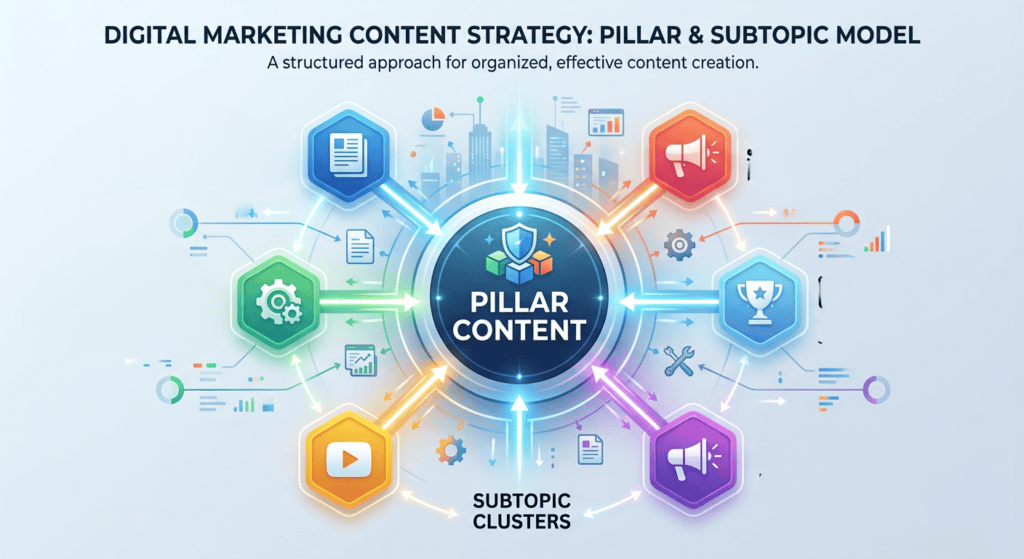
A pillar page is a comprehensive resource covering a broad topic that’s important to your business. It provides an in-depth overview while linking to more specific articles that explore individual aspects of that subject. Those supporting articles are your subtopics.
For example, a digital marketing agency might create a pillar page about content marketing. Supporting articles could cover topics such as keyword research, content audits, internal linking, content refreshes, and developing a content calendar. Each article addresses a specific search or customer question, but together they demonstrate depth of knowledge about the broader topic. This is the key difference between strategic content and simply publishing blog posts whenever someone has an idea.
Every article has a purpose and contributes to a larger strategy.
Why Pillar and Subtopic Content Matters for SEO
Search engines need context to understand what your website is about and how your individual pages relate to one another. A collection of disconnected blog posts doesn’t necessarily provide that context. You might have excellent articles about related subjects, but if they aren’t organized or connected strategically, you’re missing an opportunity to establish topical depth.
A pillar-and-subtopic structure creates those connections.
Your pillar page provides broad coverage of an important subject, while supporting articles explore related questions in greater detail. Internal links connect the pages, helping users navigate between related information while giving search engines additional context about the relationships between your content.
The result is a website that’s easier to understand and easier to navigate.
More importantly, it gives your customers a better experience. Someone who starts with a broad question can move naturally into more detailed information without having to return to Google and start their search all over again.
Start With the Right Core Topics
The success of a pillar content strategy depends on choosing the right topics. Not every subject deserves to become a pillar page. Your core topics should have a meaningful connection to your products, services, expertise, and customers.
Start by considering what your business wants to be known for. Then look at the questions your customers ask before, during, and after making a purchasing decision. Keyword research can help identify how people search for information, but search volume shouldn’t be the only consideration. Search intent matters just as much.
A topic with thousands of searches isn’t necessarily valuable if the people searching aren’t potential customers. The better question is: Does this topic connect our expertise with something our audience actually needs to know?
When the answer is yes, you’ve found a stronger candidate for pillar content.
Create Pillar Content That Actually Answers the Question
A pillar page shouldn’t exist simply because you want to target a particular keyword.
It should be genuinely useful.
That means covering the subject thoroughly, organizing information logically, answering common questions, and providing enough context for readers to understand the topic without feeling overwhelmed.
Good pillar content also creates opportunities for deeper exploration. When a subject deserves more explanation than the pillar page can reasonably provide, link to a dedicated subtopic article.
Think of the pillar page as the central resource and the subtopic articles as supporting resources that allow readers to go deeper. This structure also gives your content strategy room to grow. As new questions emerge or you identify additional gaps, you can create supporting content and connect it back to the appropriate pillar.
Use Subtopic Articles to Build Depth
Subtopic articles give you an opportunity to answer the specific questions surrounding your broader topic. These might be informational searches, comparisons, how-to questions, definitions, or questions related to your products and services.
The goal isn’t to stretch one topic into dozens of nearly identical articles. That’s not strategic content. It’s content for content’s sake. Instead, each subtopic should provide something useful and distinct.
A strong subtopic article should answer a specific question or address a specific need while naturally connecting back to the broader topic. It should also provide opportunities to link to other relevant content throughout your website.
Over time, these articles create a deeper library of information that supports your pillar content and gives customers more opportunities to discover your business.
Internal Linking Connects the Strategy
Internal linking is one of the most important parts of a pillar-and-subtopic strategy. Publishing related articles isn’t enough. Those articles need to be connected.
A subtopic article should link back to its relevant pillar page when appropriate. The pillar page should link out to supporting articles. Related subtopics can also link to one another when doing so helps the reader. This creates a network of related information rather than a collection of isolated pages.
Internal links also help visitors discover additional information without leaving your website. If someone is reading about content audits and you have a more detailed article explaining how to perform one, that link gives them an obvious next step.
The best internal linking strategies don’t just add links for SEO. They improve the user’s journey through your website.
Pillar Content Can Strengthen Your Brand Authority
There’s another benefit to this strategy that goes beyond rankings. Comprehensive, useful content gives your business an opportunity to demonstrate what it knows. When a potential customer finds your website and sees that you’ve answered not just one question but many of the questions surrounding a particular topic, you’re building credibility.
That matters particularly for businesses with complex products or services. Customers may need significant information before they’re comfortable making a purchase or contacting a provider.
Your content can help them get there.
A well-developed content library can answer questions before a sales conversation ever begins, address objections, explain complicated concepts, and demonstrate that your business understands the problem your customer is trying to solve.
How to Build a Pillar and Subtopic Strategy
A successful strategy starts with research rather than writing.
First, identify the core topics that align with your business goals and customer needs. Then use keyword research and search-intent analysis to identify the questions and subjects that should support those topics. From there, map out your pillar and subtopic structure before creating the individual articles.
This is where content strategy becomes particularly valuable. Instead of asking, “What should we blog about this month?” you’re asking, “What information is missing from our website, and how can we build a stronger resource around this important topic?”
Once your content is published, continue evaluating it. Look at organic traffic, rankings, engagement, conversions, and the ways users move through your website. Identify content gaps and opportunities to refresh existing articles or create new supporting pieces.
A content strategy shouldn’t be static. Your customers’ questions change, search behavior changes, and your business changes. Your content should evolve with them.
The Long-Term Value of Strategic Content
One of the biggest advantages of pillar and subtopic content is that it creates value beyond a single blog post. A strategically planned article can attract organic traffic, answer a customer’s question, support another page through internal linking, and strengthen your authority around an important subject.
Then the next article can build on it.
Over time, those connections create a stronger website. One that provides more useful information to customers while giving search engines a clearer understanding of your expertise. That’s very different from publishing random articles simply to keep a blog active.
Build a Content Strategy That Works Together
Your website shouldn’t be a collection of pages that happen to share a domain name.
Your content should work together.
Pillar and subtopic content provides a framework for making that happen. By identifying the subjects that matter most to your business, creating comprehensive resources, answering specific customer questions, and connecting those pages through strategic internal linking, you can build a content library that supports both your audience and your long-term SEO goals.
We approach content strategy with that bigger picture in mind. Our blog writing campaigns are designed around business objectives, search intent, keyword research, and the relationships between your website’s most important topics and pages.
Because the goal isn’t to publish more content.
It’s to build content that works together, and works for your business.