

The Plug-and-Play AI Account Manager Myth
I keep seeing posts about letting AI “run” or “audit” your Google Ads account like it’s a plug-and-play system. Connect it, drop in a template, comment a keyword to get the file, and suddenly you’ve got an AI account manager.
I’ve been building something similar for my own work. And the thing I keep running into is this: the AI isn’t the hard part. Knowing what to tell it is.
Why Generic Benchmarks Don’t Work for Every Account
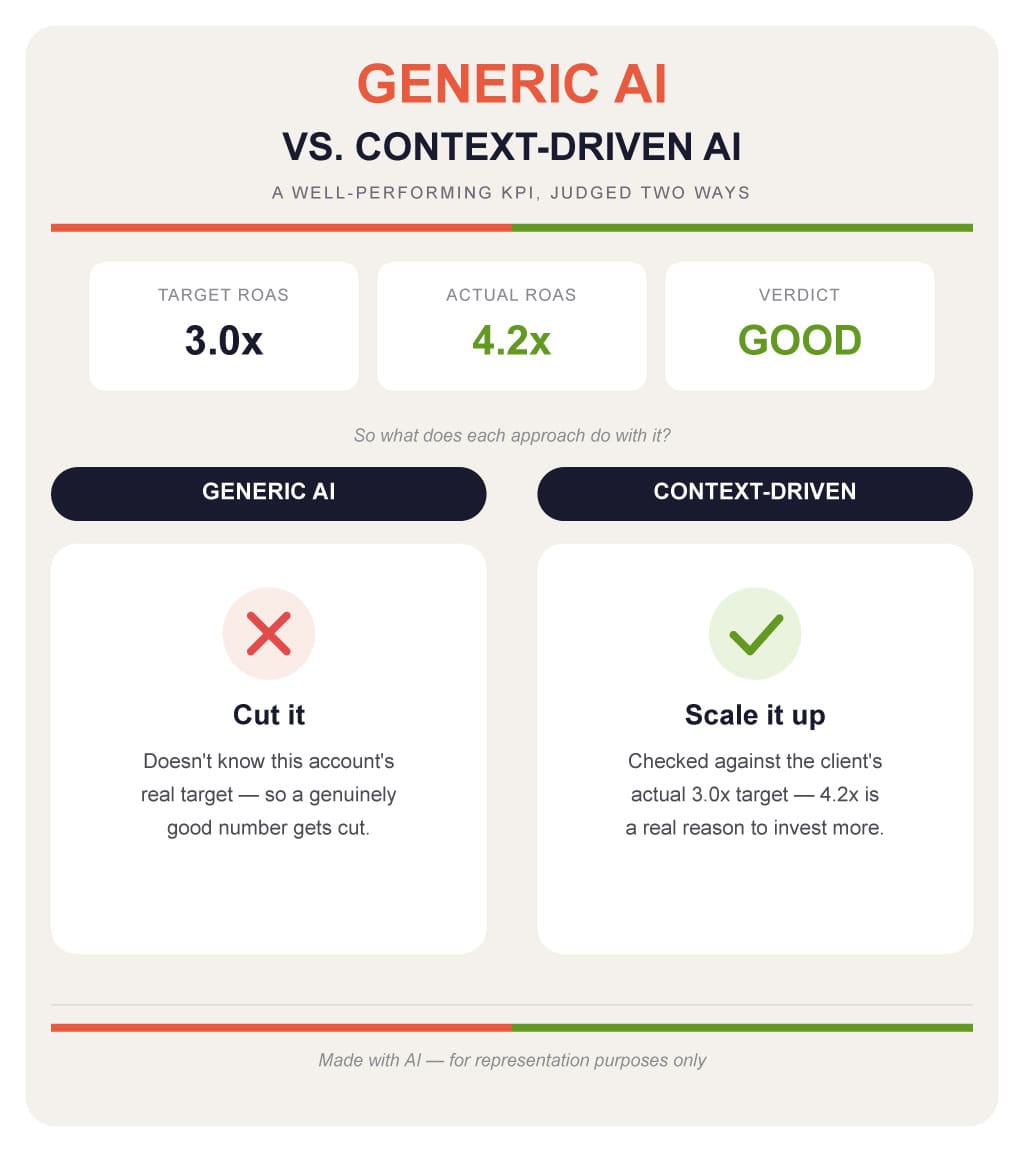
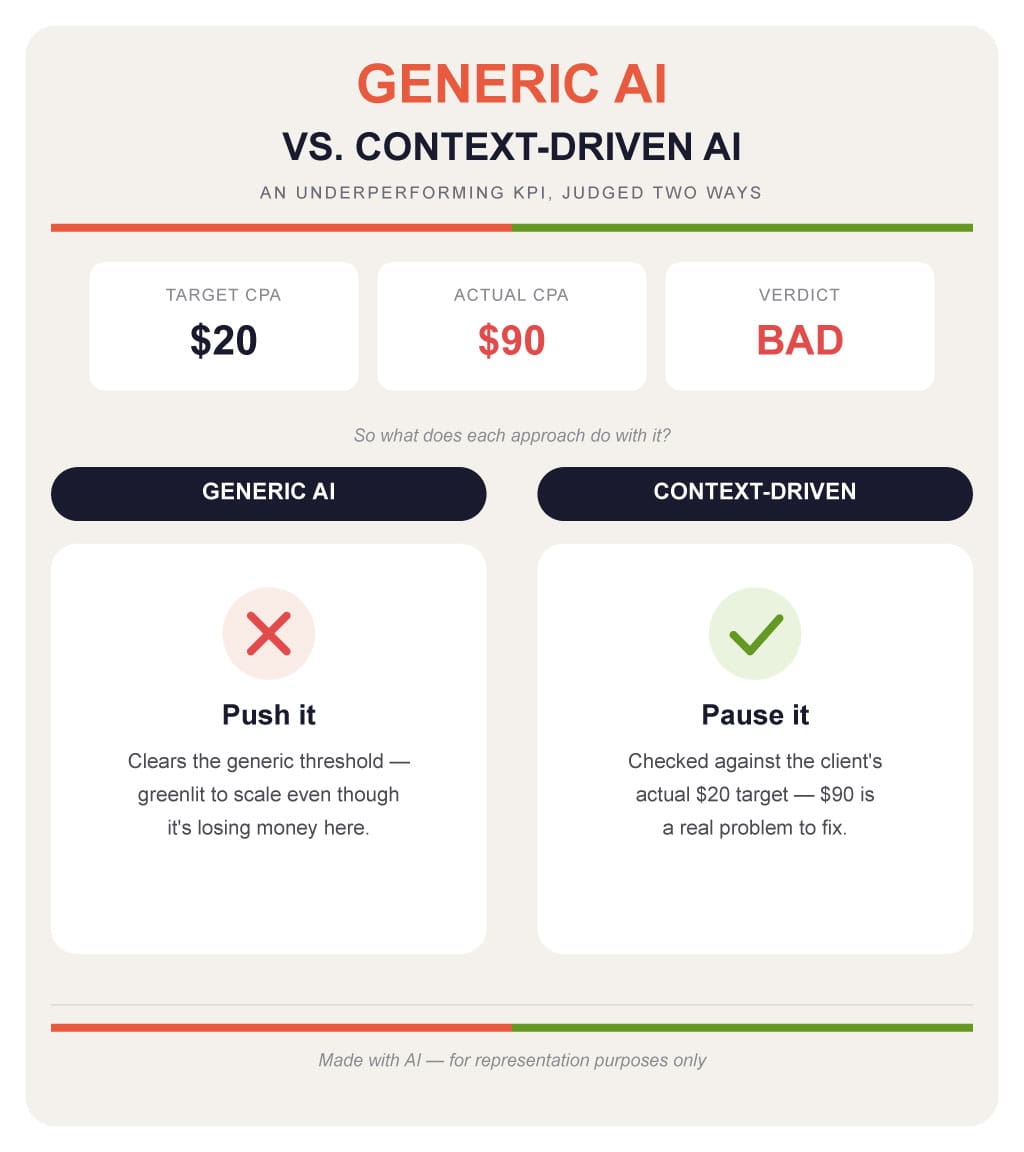
A generic audit prompt or template can tell an AI to flag a keyword after a certain number of clicks without a conversion, call out a CPA once it crosses some number, or recommend scaling once ROAS hits some other number.
The problem is those numbers don’t mean the same thing for every account.
The Same ROAS Target Doesn’t Mean the Same Thing Twice
One client might need a very high ROAS just to be profitable. Another is perfectly healthy at a fraction of that. One lead-gen account might have room to spend a lot more per lead than another. Even campaigns inside the same account often need to be judged by completely different standards.
Even Campaigns Inside One Account Need Different Standards
A template doesn’t know any of that. It can’t. It wasn’t built for your account; it was built to look impressive on someone’s feed.
Building a Context Layer Before AI Labels Anything “Good” or “Bad”
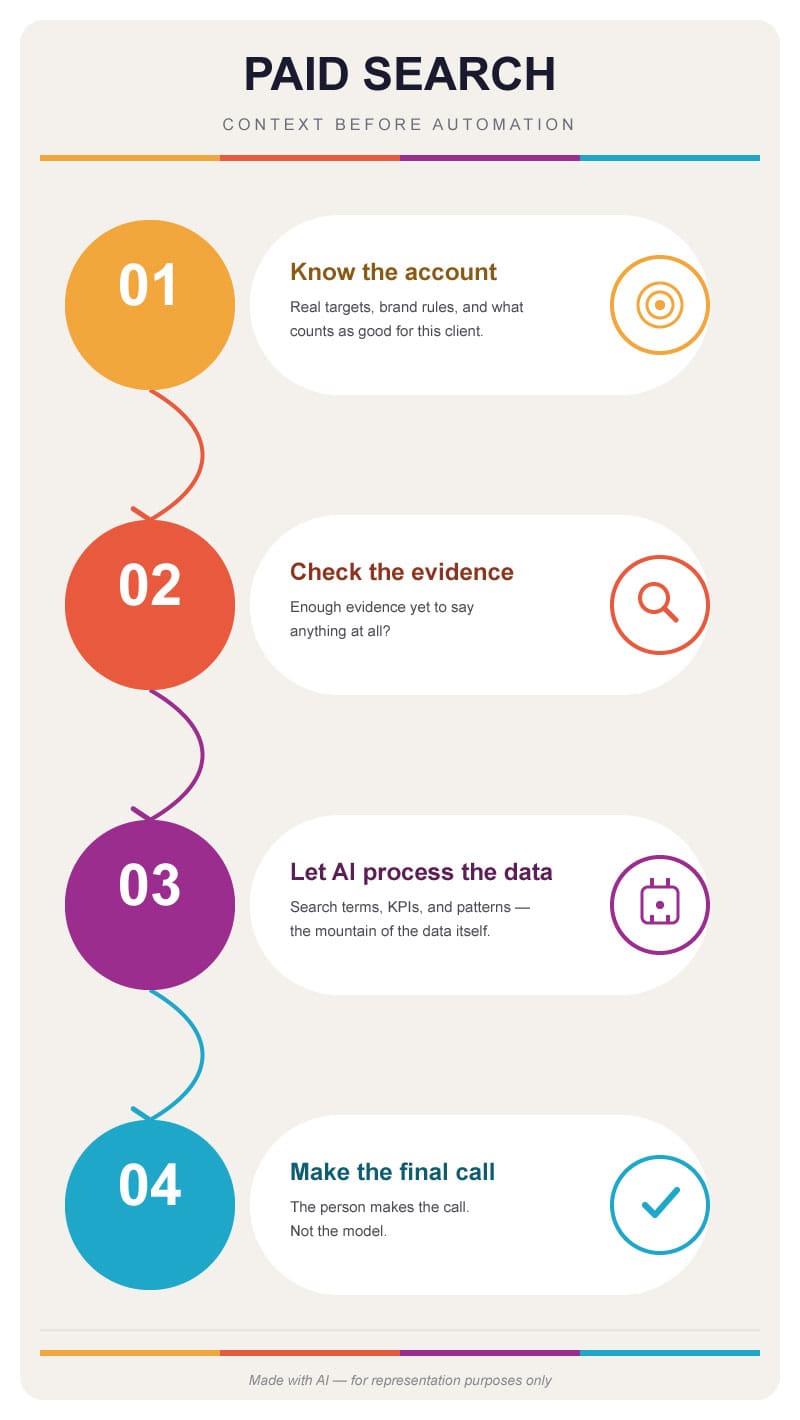
So instead of letting AI apply the same generic benchmarks everywhere, I built in a layer of context that must get checked first. Before anything gets labeled “good” or “bad,” it has to know what that actually means for that specific account, real targets, what counts as acceptable versus needs attention versus an actual opportunity, and honestly, whether there’s even enough data yet to say anything at all.
Why “Enough Evidence” Is the Metric Most AI Tools Skip
That last part gets skipped in almost every one of these plug-and-play systems. A target tells you what good looks like. It doesn’t tell you whether you have enough evidence to act on what you’re seeing. A search term with zero conversions isn’t automatically wasted spend. It might just not have enough volume yet to mean anything, and it still needs to be judged on intent, not just on the fact that it hasn’t converted.
Judgment Is Built From Managing Real Accounts, Not Templates
This is the part that seven years of running paid search taught me, and no template teaches: knowing what “enough evidence” looks like, knowing when a number is a red flag versus just noise, knowing when the client’s context matters more than the metric in front of you. That’s judgment. You build it by managing real accounts, watching what happens after you make a call, and being wrong enough times to know better.
Which is why I don’t think the AI should be making the final call, either.
There’s a real difference between using AI to get through a mountain of account data faster and letting it decide that a keyword should be paused, a search term excluded, or a budget moved. Context matters, and most of it doesn’t live in the data. It lives with whoever’s been managing that account and knows the client.
The Right Way to Use AI in Paid Search Management
So, the way I think about this is basically: know the account, know the goals, know how much evidence is enough, then let AI help you get through the data. Not the other way around.
I think this distinction is going to matter a lot more as more people start plugging AI into their ad accounts and templates start circulating that make it look this simple. You can hand an AI a really good process. If it’s working off generic benchmarks instead of what your account actually needs, you can still end up with confident, well-formatted, completely wrong recommendations.
AI is genuinely useful here. It’s just not a shortcut around knowing what you’re doing.
Author | Thomas McCullough | Paid Search Expert